
Most contact center budgets have a hidden line item nobody labels correctly: the cost of agents sitting idle, waiting for calls that aren't coming. It doesn't show up as "waste" in a P&L — it shows up buried inside payroll, blended into average cost-per-contact, or quietly absorbed as "the cost of doing business." But it's real, it's large, and it's almost entirely avoidable.
What Idle Labor Actually Costs
Idle labor isn't about agents being lazy or unproductive during downtime — it's a structural staffing problem. Most contact centers schedule shifts to guarantee coverage for their hours of operation, not their actual call volume. That distinction matters more than it sounds like it should.
If a support line is open from 8 am to 8 pm, the traditional model staffs for that entire window — even though call volume in most operations is anything but flat across those 12 hours. Demand typically spikes during a handful of peak hours and drops off sharply the rest of the time. Staff for the peak, and you're paying full wages for agents handling a fraction of that volume during every off-peak hour.
This gets measured industry-wide through a metric called occupancy rate — the percentage of an agent's logged-in time actually spent handling customer contacts (versus waiting for the next one). Low occupancy is the clearest fingerprint of idle labor cost. An agent sitting at 40% occupancy is being paid for a full hour but productively engaged for less than 25 minutes of it.
A Real Example: What This Looks Like in Practice
A multi-brand franchise organization with 16 different service brands ran into this exact problem. Their customer care model staffed to cover hours of operation rather than actual call volume, which meant agents routinely sat through long stretches of low-volume time while still drawing full wages. The result: persistently low occupancy rates and — somewhat counterintuitively — double-digit call abandonment rates even while overstaffed, because the staffing model wasn't actually aligned with when calls were arriving.
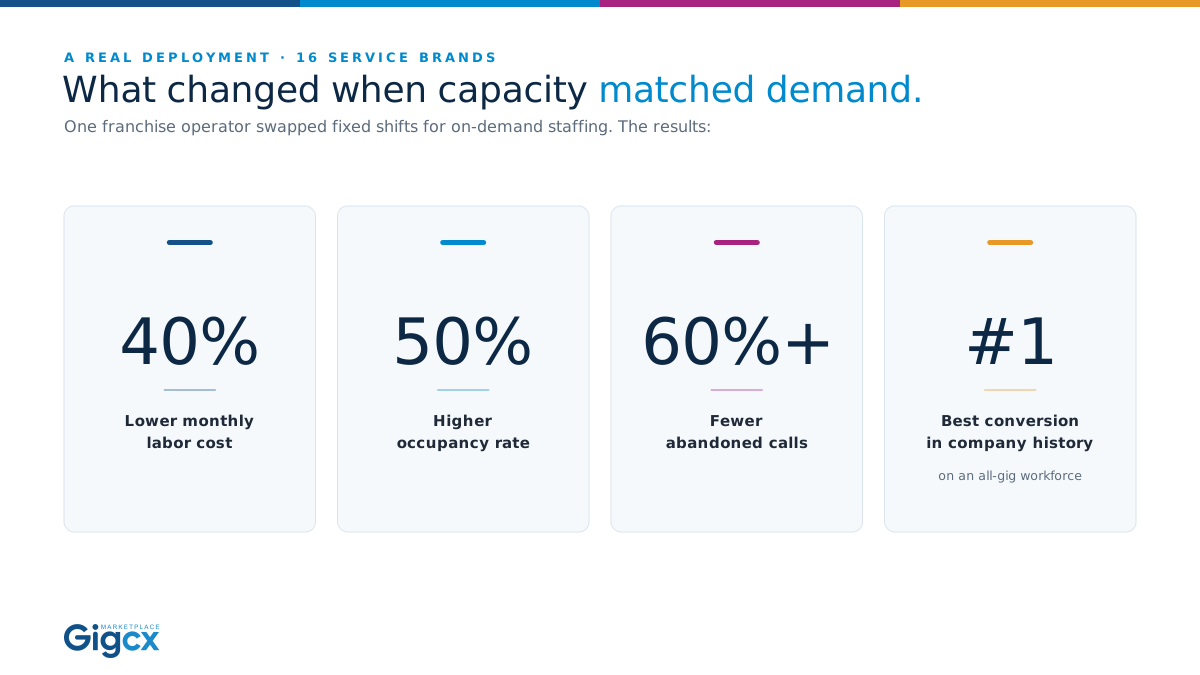
When the organization shifted to a flexible, on-demand staffing model — scaling agent capacity up and down based on real call arrival patterns instead of fixed shift coverage — the results were significant:
- 30–40% reduction in monthly labor costs, simply by paying for active capacity instead of scheduled hours
- A 50% improvement in occupancy rate
- Abandonment rates improved by over 60% — proof that the old "overstaff to be safe" instinct wasn't even solving the problem it was meant to solve
- The highest conversion rate in company history, achieved using an all-gig-based work group
That last point is worth sitting with. The assumption behind most idle-labor staffing is that more bodies in seats equals better service. This organization's experience suggests the opposite: a workforce sized correctly to actual demand outperformed a workforce sized to "be safe," on both cost and quality.
How to Reduce Contact Center Staffing Costs Without Outsourcing
The instinct when labor costs run high is often to look at outsourcing — but outsourcing doesn't fix a staffing-pattern problem, it just moves it. The actual fix is reducing the gap between scheduled capacity and real demand, not finding a cheaper way to staff the same fixed pattern.
That means three concrete things, in order:
- Measure occupancy by hour, not just by day. Daily averages hide the problem — a center can average 75% occupancy while running at 40% for six hours and 95% for two. The hourly view is where idle cost actually becomes visible.
- Separate "hours of operation" from "hours of real demand." Being open 12 hours doesn't mean you need full staffing for 12 hours. Map your actual call-volume curve and staff to that curve, not the storefront hours.
- Build in a flexible capacity layer instead of a second fixed shift. Adding more full-time or BPO capacity to cover a peak just adds a second fixed cost. An on-demand layer that scales hour-to-hour solves the timing mismatch without creating a new one.
Why Traditional Staffing Models Can't Solve This
This isn't a failure of effort or planning — it's a structural limitation of fixed-shift staffing. A traditional employment model requires committing to shift blocks (4, 6, 8 hours) regardless of how volume moves within that block. Even sophisticated workforce management software can only optimize within the constraint of pre-committed shifts; it can't eliminate the underlying mismatch between fixed labor blocks and variable demand.
Traditional outsourcing (BPO) models often don't solve this either. Many BPO contracts include minimum staffing or volume commitments that simply move the idle-cost problem from your balance sheet to a line item inside a vendor's invoice instead.
The Fix: Matching Capacity to Real-Time Demand
An on-demand, gig-based CX workforce — the model GigCX enables through the GigCX Marketplace platform — sidesteps this constraint entirely. Instead of scheduling shift blocks and hoping volume cooperates, organizations can deploy agent capacity in much finer increments, scaling in near real-time as call patterns actually unfold throughout the day.
This is the core mechanism behind GigCX Marketplace's lifecycle model: because agents are sourced, vetted, and trained in advance through the platform, capacity can flex hour-to-hour rather than being locked into shift-length commitments. The cost savings aren't from cheaper labor — they're from eliminating the gap between scheduled capacity and actual demand.
How to Tell If Idle Labor Is Costing You
A few warning signs worth checking against your own operation:
- Occupancy rates consistently below 70–75% during a meaningful share of operating hours
- Abandonment rates that stay high even when you're fully staffed — often a sign that staffing is misaligned with when calls arrive, not just how many arrive
- Staffing decisions driven primarily by hours of operation rather than historical call-volume curves
- Seasonal or time-of-day patterns that are well understood internally but not reflected in the staffing model
If more than one of these sounds familiar, the cost isn't hypothetical — it's already showing up in your numbers, just not labeled as what it is.
The Bottom Line
Idle labor cost is one of the most consistently underestimated line items in contact center economics, precisely because it hides inside normal payroll rather than appearing as its own category. The fix isn't working agents harder or cutting headcount blindly — it's matching staffing precision to the way demand actually moves, which fixed-shift models structurally can't do, and on-demand workforce models are built specifically to solve.
Curious how a fully on-demand staffing model actually works day to day?
Read our field guide to GigCX for a breakdown of the full workforce lifecycle, from recruiting through scheduling and payment.
Interested in learning more about the GigCX Marketplace?
