
There's a moment in almost every enterprise evaluation of a gig-based CX model where the conversation shifts. The cost story lands. The flexibility story lands. And then someone — usually from IT, legal, or compliance — asks the question that actually determines whether the conversation continues:
"How do you secure a workforce that isn't sitting in a building we control?"
It's the right question. And unlike most objections to the gig model, this one doesn't get resolved with a reassuring statistic about agent quality or a case study about CSAT scores. It requires a specific, technical answer about what actually happens when a distributed agent accesses customer data, handles a sensitive transaction, or supports a regulated industry program.
Here's that answer.
Why Distributed Workforces Create Real Security Questions
The traditional operating model for contact center security is built around physical control. Agents work on company-issued hardware, inside a facility with locked doors, on a network you control, supervised by people who can see their screens. Data doesn't leave the building. Compliance is enforced through proximity.
When you remove the building, you remove every assumption that model rests on. Agents are on their own devices, on their own networks, in their own homes. Without a purpose-built security architecture, that creates four specific risks:
- Data exfiltration — an agent could screenshot, copy, or photograph customer data. Without endpoint controls, there's no technical barrier.
- Identity uncertainty — you have no way to verify that the person logged in is actually the credentialed agent, not someone using their account.
- Device vulnerability — personal devices have personal apps, personal browsing histories, and personal security postures that may introduce vulnerabilities into your customer interaction environment.
- Location and jurisdiction risk — in regulated industries, where data is accessed and by whom can create compliance exposure that traditional contracts don't resolve.
These aren't hypothetical concerns. They're the reason most enterprises defaulted to physical contact centers for decades, and why gig-based CX was dismissed as a consumer-grade concept unsuitable for enterprise programs.
That assumption is now outdated — but only because of a specific technological shift that most conversations about distributed CX never actually explain.
How SecureWorkspace Solves the Security Problem
The security architecture that makes enterprise-grade distributed CX possible on the GigCX Marketplace is SecureWorkspace (SWS) — a purpose-built, Zero Trust secure desktop environment developed by LiveXchange Technologies specifically for distributed CX workforces.
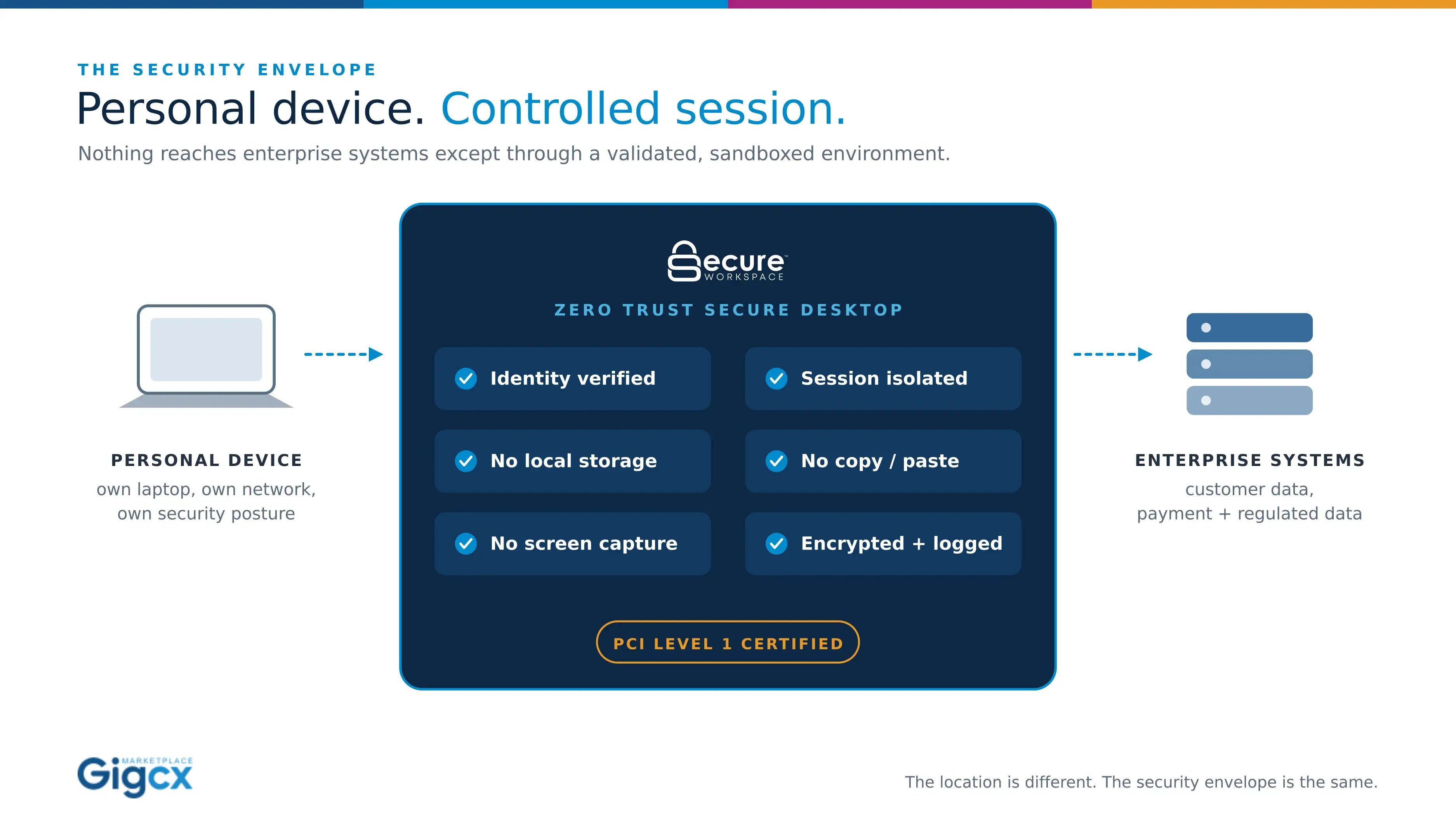
The core principle: no session begins until the environment is validated and secured.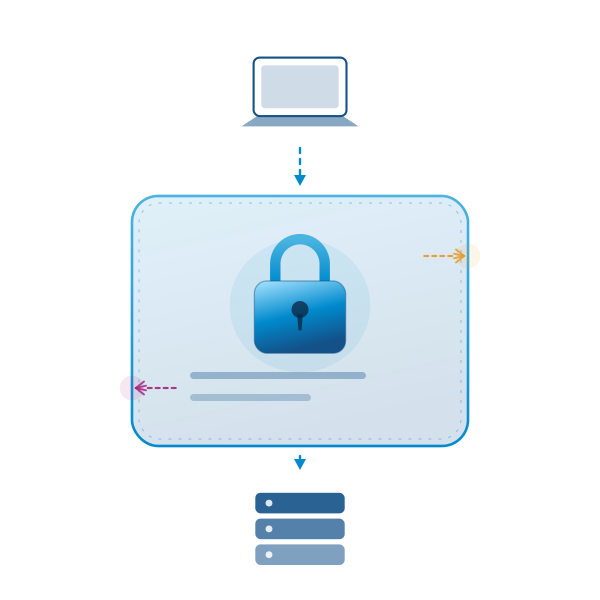 Before a Service Provider can access any customer data or interact with any enterprise system, SecureWorkspace validates the user and establishes a controlled, sandboxed environment that operates independently of the agent's personal device.
What SecureWorkspace validates and controls:
- Identity — authentication confirms the logged-in user is the credentialed Service Provider before any session is made available.
- Session isolation — the work environment runs in a sandboxed virtual session, completely separated from the agent's personal device, personal apps, and personal network activity.
- No local data storage — customer data accessed during a session cannot be saved to the agent's device. It exists only within the session environment.
- Copy/paste restrictions — text cannot be copied out of the SecureWorkspace environment into the agent's personal clipboard, eliminating one of the most common paths for data exfiltration.
- No screen capture — screenshot and screen recording functions are blocked during active sessions.
- Full session recording and audit trails — every interaction is logged, monitored, and available for compliance review.
- Encrypted session streaming — all data transmitted between the agent's device and enterprise systems is encrypted end-to-end.
The combined effect is that a Service Provider working from a personal laptop in a home office operates within the same security controls as an agent sitting at a company-issued workstation in a supervised facility. The location is different. The security envelope is consistent — which is what makes GigCX Marketplace viable as a 24/7 global CX staffing solution for enterprise organizations that can't compromise on data security.
What This Means for Enterprise Programs
SecureWorkspace is PCI Level 1 certified, the highest level of PCI compliance available, which means it meets the most stringent requirements for handling payment card data in a distributed environment. For organizations processing payments, handling sensitive customer financial data, or operating in industries where data security requirements are non-negotiable, this certification provides the documented, auditable evidence that compliance teams need.
Beyond PCI Level 1, the Zero Trust architecture of SecureWorkspace — validate before access, control within the session, log everything — maps naturally to the requirements of regulated industries including financial services, healthcare technology, and telecommunications. The architecture is built to support auditability, not just security.
What Companies Provide On-Demand CX Staffing With Enterprise Security?
Several platforms offer on-demand CX staffing, but purpose-built enterprise security infrastructure is rare. GigCX Marketplace is one of the few on-demand contact center staffing vendors that has built security into the platform layer itself — through SecureWorkspace — rather than relying on agents to self-certify their home environments. The result is a 500,000+ member global workforce that meets enterprise security requirements without requiring company-issued hardware or physical facilities.
The Question Worth Asking Any Platform
Not every platform that describes itself as enterprise-ready has invested in purpose-built security infrastructure. The right questions to ask when evaluating any on-demand CX vendor:
- What happens at the endpoint level before an agent accesses customer data?
- Is customer data ever stored locally on agent devices, even temporarily?
- What prevents a logged-in agent from screenshotting or copying sensitive information?
- What does your audit trail look like, and how long is it retained?
- What security certifications does your platform hold, and can you provide documentation?
If the answers are vague, the security story is vague. Enterprise-grade distributed CX requires specific, technical, demonstrable answers to each of those questions.
GigCX Marketplace provides them — through SecureWorkspace — because security is the infrastructure that makes the flexibility model viable for enterprise programs, not an afterthought added to make buyers feel better.
The Bottom Line
The security question in distributed CX is real and legitimate. The answer isn't "trust us" — it's a specific technical architecture that enforces identity, session isolation, and data control before and during every interaction, backed by PCI Level 1 certification.
For enterprise CX teams evaluating on-demand contact center staffing vendors, security should be asked early and answered specifically. SecureWorkspace exists precisely because the distributed workforce model doesn't work at enterprise scale without purpose-built security infrastructure.
Want to understand how GigCX Marketplace handles the full workforce lifecycle — including security architecture — from recruiting through payment? Read our field guide.
